Arbeitsblatt: Repetitions-/Aufarbeitungsdossier New World 1, Unit 1
Material-Details
Dossier zur Repetition, Aufarbeitung oder Vertiefung von New World 1, Unit 1
Englisch
Lehrmittel
6. Schuljahr
7 Seiten
Statistik
214197
339
1
08.12.2025
Autor/in
Martina Graf
Land: Schweiz
Registriert vor 2006
Textauszüge aus dem Inhalt:
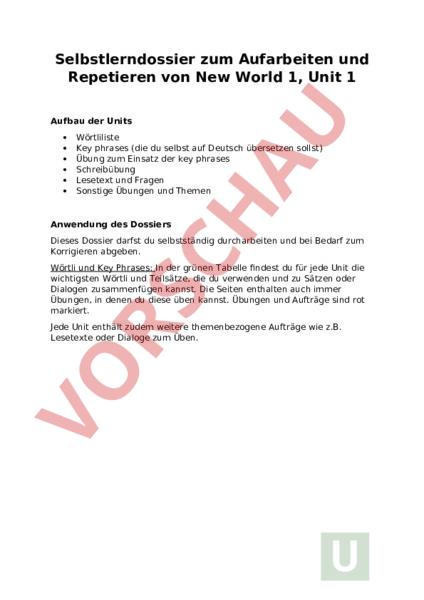
Selbstlerndossier zum Aufarbeiten und Repetieren von New World 1, Unit 1 Aufbau der Units Wörtliliste Key phrases (die du selbst auf Deutsch übersetzen sollst) Übung zum Einsatz der key phrases Schreibübung Lesetext und Fragen Sonstige Übungen und Themen Anwendung des Dossiers Dieses Dossier darfst du selbstständig durcharbeiten und bei Bedarf zum Korrigieren abgeben. Wörtli und Key Phrases: In der grünen Tabelle findest du für jede Unit die wichtigsten Wörtli und Teilsätze, die du verwenden und zu Sätzen oder Dialogen zusammenfügen kannst. Die Seiten enthalten auch immer Übungen, in denen du diese üben kannst. Übungen und Aufträge sind rot markiert. Jede Unit enthält zudem weitere themenbezogene Aufträge wie z.B. Lesetexte oder Dialoge zum Üben. Unit 1: Getting together Lernziele: Du kannst dich vorstellen und kurze Kennenlerngespräche führen. einen Text über einen Schüleraustausch lesen und Fragen dazu auf Deutsch beantworten. die wichtigsten Wörter zum Thema «Reisen» Vociliste Englisch Deutsch school exchange Schüleraustausch country Land excited aufgeregt nervous nervös host family host families Gastfamilie Gastfamilien passport control Passkontrolle customs Zoll afraid (of) Angst haben (vor) mistake Fehler make friends Freunde finden busy streets belebte Straßen understand verstehen friendly freundlich house rules Hausregeln take off (your shoes) (die Schuhe) ausziehen help with cooking beim Kochen helfen introduce yourself dich vorstellen home country Heimatland polite höflich homesick Heimweh haben to miss (someone) (jemanden) vermissen every day jeden Tag to learn lernen to meet treffen to speak sprechen public transport Der öffentliche Verkehr Experience Die Erfahrung Auftrag: Übe die Vocis und achte darauf, dass du vorallem die fettgedruckten aussprechen und schreiben kannst. Fülle anschliessend den Lückentext mit den gelernten Vocis aus. 1. dont Do you German? 2. The people in Bönigen are very and always say hello. 3. dont think we know each other. Can you please? 4. Your clothes are dirty. Can you outside, please? 5. Im of spiders. Key Phrases My name is Whats your name? Nice to meet you. Where are you from? Im from live in Could you please speak more slowly? Im sorry, dont understand. Can you repeat that, please? Auftrag: 1. Schreib einen kurzen Dialog, indem du die Key phrases verwendest. Wenn du einen Satz schreiben möchtest, der nicht in der Tabelle ist, kannst du jemanden fragen und dann den Satz gleich in die Tabelle einfügen. 2. Übe den Dialog mit deinem Lernpartner oder deinen Eltern. 3. Überlege dir weitere Sätze, die du in einem Kennenlerngespräch Lesetext Auftrag: 1. Lies den Text durch und markiere Wörter, die du noch nicht kennst. Füge die wichtigsten in die Vociliste auf Seite 2 ein. 2. Beantworte die Quizfragen zum Text und beantworte anschliessend die Fragen. School exchange group of teenagers flies to another country for school exchange. They feel excited and bit nervous. Everything is new and different for them. At the airport, they go through passport control and customs. Then they meet their host families. Some students are scared to speak English all the time. They are afraid of making mistakes. Other students are happy and want to see new culture and make new friends. On the way from the airport, they look out of the window. They see tall buildings and busy streets. The buses and trains are different from home. People speak very fast, and the teenagers do not understand every word. The host families are friendly. They show the teenagers their rooms and explain simple house rules. In some families, the students take off their shoes at the door and help with cooking in the evening. At school, the teenagers introduce themselves to the class. They say their names and talk about their home countries. They learn easy phrases like Where is the station?, Can have sandwich, please?, and Sorry, dont understand. The teachers tell them to be polite and to listen carefully. Sometimes the teenagers feel homesick and miss their families and friends. They write short messages to them. In the afternoon, they visit parks and famous places. In the evening, they talk with their host families about their day. Every day they understand more English and feel better when they speak. They see that it is okay to make mistakes and that they can learn from them. Quizfragen 1. Why do some students feel nervous? a) They dont like flying. b) They must speak English all the time. c) They dont like their own school. 2. What do the teenagers see on the way from the airport? a) Mountains and farms b) Tall buildings and busy streets c) beach and the sea 3. What is one house rule in some host families? a) Do homework in the morning b) Take off shoes at the door c) Go to bed after midnight 4. What do the teenagers learn at school? a) Difficult grammar rules only b) Easy phrases for everyday situations c) Only sports vocabulary Short-answer questions Du kannst die Fragen auf Deutsch oder auf Englisch beantworten. 1. Why are the teenagers excited and nervous? 2. Name two things they see on the way from the airport. 3. What do some host families ask the students to do at home? 4. What do the students learn to say when they dont understand something? 5. How do the teenagers feel at the end of the exchange?