Arbeitsblatt: New York City
Material-Details
Text mit Aufgaben zum Textverständnis und Disskusion
Englisch
Lesen / Literatur
9. Schuljahr
6 Seiten
Statistik
215740
64
0
05.08.2026
Autor/in
RAFAEL STUMPP
Land: Deutschland
Registriert vor 2006
Textauszüge aus dem Inhalt:
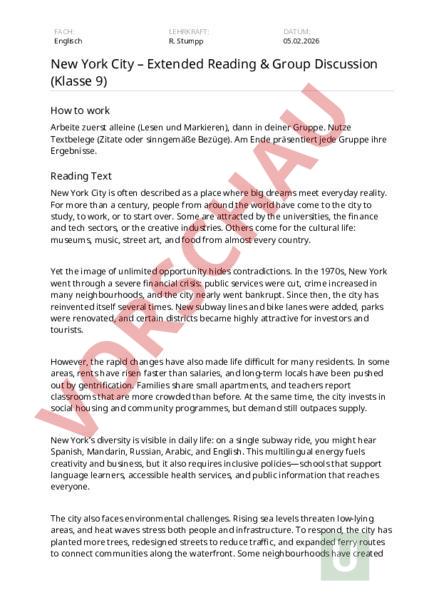
FACH: Englisch LEHRKRAFT: R. Stumpp DATUM: 05.02.2026 New York City – Extended Reading Group Discussion (Klasse 9) How to work Arbeite zuerst alleine (Lesen und Markieren), dann in deiner Gruppe. Nutze Textbelege (Zitate oder sinngemäße Bezüge). Am Ende präsentiert jede Gruppe ihre Ergebnisse. Reading Text New York City is often described as place where big dreams meet everyday reality. For more than century, people from around the world have come to the city to study, to work, or to start over. Some are attracted by the universities, the finance and tech sectors, or the creative industries. Others come for the cultural life: museums, music, street art, and food from almost every country. Yet the image of unlimited opportunity hides contradictions. In the 1970s, New York went through severe financial crisis: public services were cut, crime increased in many neighbourhoods, and the city nearly went bankrupt. Since then, the city has reinvented itself several times. New subway lines and bike lanes were added, parks were renovated, and certain districts became highly attractive for investors and tourists. However, the rapid changes have also made life difficult for many residents. In some areas, rents have risen faster than salaries, and long-term locals have been pushed out by gentrification. Families share small apartments, and teachers report classrooms that are more crowded than before. At the same time, the city invests in social housing and community programmes, but demand still outpaces supply. New Yorks diversity is visible in daily life: on single subway ride, you might hear Spanish, Mandarin, Russian, Arabic, and English. This multilingual energy fuels creativity and business, but it also requires inclusive policies—schools that support language learners, accessible health services, and public information that reaches everyone. The city also faces environmental challenges. Rising sea levels threaten low-lying areas, and heat waves stress both people and infrastructure. To respond, the city has planted more trees, redesigned streets to reduce traffic, and expanded ferry routes to connect communities along the waterfront. Some neighbourhoods have created local initiatives, like community gardens or waste reduction projects, showing that small steps can add up. For teenagers growing up in New York, the city can feel like paradox: noisy and crowded, but also full of possibilities; expensive and competitive, yet welcoming to new ideas. Whether New York is mainly exciting or mostly exhausting may depend on where you live, how much you earn, and what kind of support your community provides. What most people agree on is that the city is constantly changing—and that its future will depend on how well it balances growth with fairness and sustainability. Quick check (global detail) 1) Which factor made New York attractive again after the crisis? Complete removal of public transport Renovated parks and improved infrastructure Closing museums and schools Ending tourism completely 2) What does the text say about rents? They have stayed the same everywhere. They have risen faster than salaries in some areas. They are lower than in most other cities. They are controlled by schools. 3) Which environmental issue is mentioned? Earthquakes Rising sea levels and heat waves Volcano eruptions Snowstorms only 4) What is one example of local initiatives? Community gardens Banning all languages except English Removing trees from streets Closing ferry routes Comprehension (write full sentences) 1) Summarize the main idea of the text in 3–4 sentences. 2) Name three contrasts the author presents (e.g., opportunity vs. inequality). Explain each briefly. 3) How does diversity shape daily life in New York? Use one concrete example from the text. 4) Which measures does the city take to address environmental challenges? Evaluate their possible impact in two sentences. 1 2 3 4 5 6 7 8 9 10 11 12 13 14 15 16 Vocabulary in context (gap fill) 1) can force who have lived there long time to leave their when rents go up fast. 2) Public are things like schools, health care, and transport that should be able to. 3) new lines and can change how people live every day. 4) and social try to help who have to pay lot to live there. 5) problems like higher sea levels need for long time. Group work – Prepare the discussion Arbeitsauftrag (Gruppen à 4): Rolle verteilen: Facilitator (leitet), Evidence Finder (Textbelege), Summarizer (fasst zusammen), Presenter (stellt vor). Zeit: 12 Min Vorbereitung, 8 Min Präsentation/Diskussion. Gruppe – Opportunity Innovation Formuliere zwei Claims (Behauptungen) darüber, warum New York Chancen bietet. Stütze jeden Claim mit 2 Textbelegen. Gruppe – Costs Inequality Formuliere zwei Claims zu Nachteilen (z. B. Mieten, Verdrängung). Belege jeden mit 2 Beispielen aus dem Text. Gruppe – Sustainability Transport Entwirf drei konkrete Maßnahmen, die die Stadt weiter umsetzen sollte. Verknüpfe jede Maßnahme mit einem Problem aus dem Text. Gruppe – Culture Community Entwickle drei Ideen, wie Nachbarschaften ihre Kultur bewahren können, während sich die Stadt verändert. Nutze mindestens 2 Textbelege. 1 2 3 4 5 6 7 8 9 10 11 12 13 14 15 16 17 18 19 20 Language support – use in your discussion Use these starters: In my view, The text suggests that One example is A strength is because A problem is since We recommend This could improve Compared to Aufgabe: Schreibe deinen Abschluss-Standpunkt in 3 Sätzen und nutze zwei der Satzstarter. Exit ticket Notiere kurz: 1) Was ist für dich die wichtigste Aussage des Textes? 2) Welche Frage würdest du der Klasse stellen, um die Diskussion zu vertiefen?