Arbeitsblatt: Sentence structure /Adverbs of frequency
Material-Details
Sentence structure present simple with adverbs of frequency
Beyond for Switzerland A2+ Unit 1
Englisch
Grammatik
7. Schuljahr
3 Seiten
Statistik
215947
1
0
07.09.2026
Autor/in
Susan Eggenberger
Land: Schweiz
Registriert vor 2006
Textauszüge aus dem Inhalt:
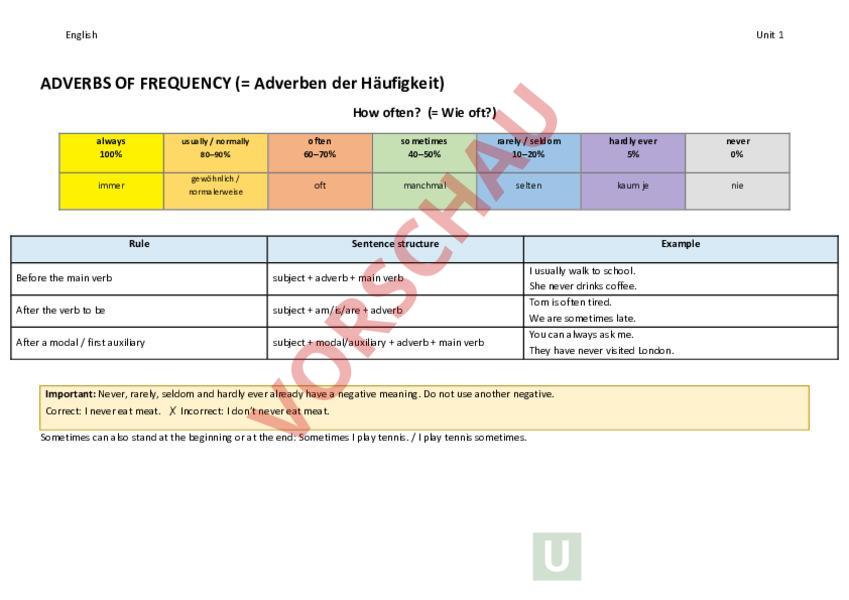
English Unit 1 ADVERBS OF FREQUENCY ( Adverben der Häufigkeit) How often? ( Wie oft?) always 100% usually normally 80–90% often 60–70% sometimes 40–50% rarely seldom 10–20% hardly ever 5% never 0% immer gewöhnlich normalerweise oft manchmal selten kaum je nie Rule Sentence structure Before the main verb subject adverb main verb After the verb to be subject am/is/are adverb After modal first auxiliary subject modal/auxiliary adverb main verb Example usually walk to school. She never drinks coffee. Tom is often tired. We are sometimes late. You can always ask me. They have never visited London. Important: Never, rarely, seldom and hardly ever already have negative meaning. Do not use another negative. Correct: never eat meat. Incorrect: dont never eat meat. Sometimes can also stand at the beginning or at the end: Sometimes play tennis. I play tennis sometimes. English Gateway A2 Unit 1 SENTENCE STRUCTURE Positive affirmative Denise normally has lunch at home on Mondays. SUBJECT ADV. OF FREQUENCY MAIN VERB OBJECT ADV. OF PLACE ADV. OF TIME Denise doesnt normally have lunch at home on Mondays. SUBJECT AUX. VERB NOT ADV. OF FREQUENCY MAIN VERB OBJECT ADV. OF PLACE ADV. OF TIME Does Denise normally have lunch at home on Mondays? AUX. VERB SUBJECT ADV. OF FREQUENCY MAIN VERB OBJECT ADV. OF PLACE ADV. OF TIME Negative – Interrogative Adverbs of frequency stand before the main verb. Exception: after the verb to be: Denise is always late. Peter is never happy. With modal verbs or auxiliaries: after the modal/first auxiliary: She can usually come. We have never seen it. English Gateway A2 Unit 1 EXPRESSIONS OF FREQUENCY ( Häufigkeitsausdrücke) Expressions of frequency tell us how many times or on which regular occasions something happens. Expression German every day week month year jeden Tag jede Woche jeden Monat jedes Jahr once day week month year einmal pro Tag Woche Monat Jahr twice day week month year zweimal pro Tag Woche Monat Jahr three four . times week drei- viermal . pro Woche on Mondays at weekends montags am Wochenende in the morning afternoon evening am Morgen Nachmittag Abend Usual position Possible position for emphasis Question Example practise English every day. We go swimming once week. She checks her messages twice day. They train three times week. He plays football on Saturdays. often read in the evening. At the end of the sentence: go to the gym twice week. We have English on Mondays. At the beginning: Every Saturday, we visit our grandparents. Once month, our class goes to the library. How often .? How often do you play volleyball? – Twice week. How often is Mia late? – Hardly ever. ADVERB OR EXPRESSION? Type Adverb of frequency Expression of frequency Position usually in the middle of the sentence usually at the end of the sentence Word order: often play tennis on Saturdays. (adverb before the main verb expression at the end) Example usually get up at seven. get up at seven every day.