Arbeitsblatt: Quiz Australia
Material-Details
Quiz mit Lösungen zu den grundlegenden facts about Australia.
Habe das Quiz als Einstieg verwendet, um herauszufinden wieviel die Schüler bereits über das Land wissen. Erneuter Test am Ende der Sequenz, um zu zeigen, was gelernt wurde.
Englisch
Anderes Thema
9. Schuljahr
2 Seiten
Statistik
56858
829
5
13.03.2010
Autor/in
Kristina Nöther
Land: Deutschland
Registriert vor 2006
Textauszüge aus dem Inhalt:
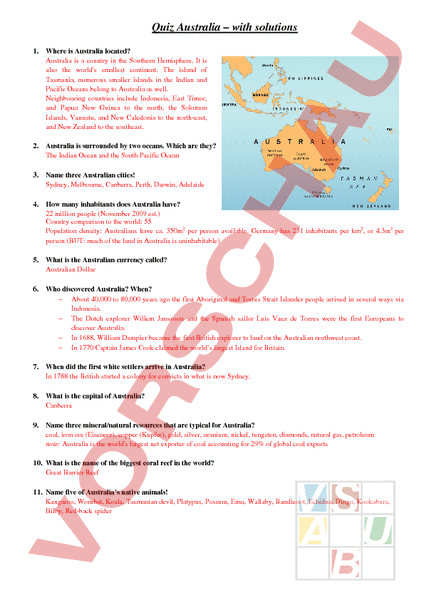
Quiz Australia – with solutions 1. Where is Australia located? Australia is country in the Southern Hemisphere. It is also the world smallest continent. The island of Tasmania, numerous smaller islands in the Indian and Pacific Oceans belong to Australia as well. Neighbouring countries include Indonesia, East Timor, and Papua New Guinea to the north, the Solomon Islands, Vanuatu, and New Caledonia to the north-east, and New Zealand to the southeast. 2. Australia is surrounded by two oceans. Which are they? The Indian Ocean and the South Pacific Ocean 3. Name three Australian cities! Sydney, Melbourne, Canberra, Perth, Darwin, Adelaide 4. How many inhabitants does Australia have? 22 million people (November 2009 est.) Country comparison to the world: 55 Population density: Australians have ca. 350m2 per person available. Germany has 231 inhabitants per km2, or 4.3m2 per person (BUT: much of the land in Australia is uninhabitable) 5. What is the Australian currency called? Australian Dollar 6. Who discovered Australia? When? About 40,000 to 80,000 years ago the first Aboriginal and Torres Strait Islander people arrived in several ways via Indonesia. The Dutch explorer Willem Janszoon and the Spanish sailor Luis Vaez de Torres were the first Europeans to discover Australia. In 1688, William Dampier became the first British explorer to land on the Australian northwest coast. In 1770 Captain James Cook claimed the worlds largest Island for Britain. 7. When did the first white settlers arrive in Australia? In 1788 the British started colony for convicts in what is now Sydney. 8. What is the capital of Australia? Canberra 9. Name three mineral/natural resources that are typical for Australia? coal, iron ore (Eisenerz), copper (Kupfer), gold, silver, uranium, nickel, tungsten, diamonds, natural gas, petroleum note: Australia is the world largest net exporter of coal accounting for 29% of global coal exports 10. What is the name of the biggest coral reef in the world? Great Barrier Reef 11. Name five of Australias native animals! Kangaroo, Wombat, Koala, Tasmanian devil, Platypus, Possum, Emu, Wallaby, Bandicoot, Echidna, Dingo, Kookabura, Bilby, Red-back spider 12. What is special about the Australian animals! 80% of the Australian animals can only be found in Australia (they are endemic). This is result of Australia long period of isolation from other continents. Mammals: any animal that gives birth to live babies, not eggs, and feeds its young on milk Monotremes: class of animal including the echidna and the platypus, which lays eggs, but also gives milk to its babies Marsupials: any Australian animal that carries its young in pocket of skin (pouch) on the mothers stomach. Kangaroos and koalas are marsupials. The mammal groups that show the highest level of endemism are the monotremes and marsupials. Today, monotremes are only found in Australia and New Guinea while marsupials are found in Australia, New Guinea, Indonesia, South America and North America. New Guinea and Australia have relatively similar mammal faunas, because they were once one land mass until 15 million years ago when the land bridge between them subsided. 13. What is the name of the native Australians? Aborigine 14. What are the „Flying Doctors? The Royal Flying Doctor Service of Australia is an air ambulance service for those living in the far away inland areas of Australia. It is not-for-profit organisation which provides both emergency assistance and primary health care to people who cannot easily get to hospital or general practice, because of the far distances in the Outback. The Service also assists with distance education. 15. What is the largest and oldest city in Australia? Sydney 16. Name five Australian tourist attractions! Great Barrier Reef, Opera House, Blue Mountains, Fraser Island Uluru (Ayers Rock) Kakadu National Park, Kangaroo Island, Albany, Shark Bay, Art Gallery of NSW, The Great Ocean Road 17. What is the most famous building in Sydney? Sydney Opera House 18. Who is Australia‘s prime minister? chief of state: Queen of Australia ELIZABETH II (since 6 February 1952); represented by Governor General Quentin BRYCE (since 5 September 2008) head of government: Prime Minister Kevin RUDD (since 3 December 2007); Deputy Prime Minister Julia GILLARD (since 3 December 2007) 19. What are typical Australian sports? Name at least three! Aussie rules football, Rugby, Netball, Surfing, Cricket 20. Why is the British flag on the Australian flag? The British flag (Union Jack) in the upper left corner of the Australian flag acknowledges Australias historical links with the United Kingdom. Australia is former British colony, and belongs to the Commonwealth of Nations today. Queen Elizabeth II, Queen of the United Kingdom, is also the Queen of Australia, role that is different from her position as monarch of the other Commonwealth countries. The Queen is represented by the Governor-General at federal level and by the Governors at state level. Although the Constitution gives extensive executive powers to the Governor-General, these are normally exercised only on the advice of the Prime Minister.